
@Ota udeh
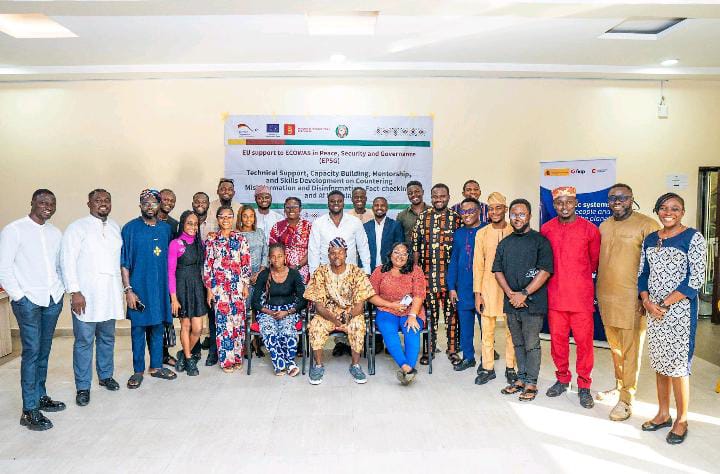
The Fundación para la Internacionalización de las Administraciones Públicas (FIAP), through its implementing partner, FactCheckAfrica, has concluded a three-day training programme aimed at strengthening the capacity of journalists, broadcasters, editors, fact-checkers and other media practitioners to produce accurate, ethical and inclusive electoral information in indigenous languages ahead of Nigeria’s 2027 general elections.
The training, held from October 13 to 15, 2026, in Akwa Ibom State, brought together 25 media practitioners and professionals involved in electoral communication for practical sessions on misinformation and disinformation, electoral terminology, translation accuracy, information verification, ethical reporting and editorial quality control.
The programme was implemented under Activity 3.1.6a(3) of the European Union Support to ECOWAS in Peace, Security and Governance (EPSG) Project, Thematic Area 1, which focuses on misinformation and disinformation, fact-checking and artificial intelligence (AI) learning.
The intervention recognises the critical role of indigenous-language communication in Nigeria’s electoral information landscape, where many citizens rely on radio broadcasts, social media, voice notes, community networks and interpersonal communication to access information. Inaccuracies arising from poor translation, misleading paraphrasing and the circulation of unverified claims can distort public understanding of electoral procedures and political developments.
Participants examined how the meaning of information can change as it is translated, summarised, forwarded or reproduced in different contexts, particularly as electoral information moves between formal media platforms and informal communication networks.
The training also explored key electoral concepts and terminology relating to voter registration, accreditation, polling units, ballot papers, the Bimodal Voter Accreditation System (BVAS), result collation, electoral offences and election petitions. Discussions emphasised the need to preserve the meaning, context and procedural accuracy of electoral information when communicating across languages.
Another major focus was the ethical responsibility of media practitioners when reporting on vulnerable and underserved communities. Participants examined how inaccurate or insensitive reporting could misrepresent communities, reinforce harmful narratives and create confusion during elections. They were encouraged to prioritise evidence-based reporting, proper attribution, contextual accuracy and careful consideration of potential harm.
The programme further equipped participants with verification and quality-control approaches for indigenous-language electoral content. These included tracing original sources, consulting official information, corroborating claims and reviewing translations before publication or broadcast.
Participants were also cautioned against circulating claims solely because they were widely shared or presented in an authoritative tone. The sessions highlighted the need for stronger editorial checks when handling electoral announcements, political claims, voice notes and election result-related information, particularly where inaccuracies could mislead voters or undermine public confidence in the electoral process.
Speaking on the significance of the intervention, Founder of FactCheckAfrica, Abideen Olasupo, said accurate communication in indigenous languages was essential to ensuring that citizens could access reliable electoral information and make informed decisions.
“Electoral information is only useful when people can understand it accurately in the language they trust and use. In a multilingual country like Nigeria, translating electoral information is not simply about changing words from one language to another; it is about preserving meaning, context and accuracy so that citizens can make informed decisions. By validating our Yoruba and Igbo electoral glossary drafts and developing an Ibibio draft from scratch, we are taking a practical step towards ensuring that indigenous-language communities are not left behind in access to reliable electoral information. These resources will help journalists and broadcasters communicate electoral concepts more consistently, verify claims more effectively and contribute to a more informed electorate ahead of the 2027 elections,” he said.
The workshop also encouraged participants to identify practical ways of incorporating the training resources into their professional and organisational workflows. The electoral language glossaries and style sheets developed through the initiative are expected to promote consistency in editorial decisions, improve translation review and strengthen the accuracy of electoral reporting beyond the training period.
The EU Support to ECOWAS in Peace, Security and Governance (EPSG) Project is a multi-donor initiative designed to strengthen peace, democratic governance and regional stability across ECOWAS member states. It is supported by the European Union (EU), the German Federal Ministry for Economic Cooperation and Development (BMZ), and the Danish Ministry of Foreign Affairs (MOFA), and jointly implemented by GIZ, Expertise France and FIAP.
