
By Ebube Bruno
Following the arrest of 17 artisanal miners in Ekuri Eyenyen and Etara communities of Etung Local Government Area of Cross River State in late August 2026, experts say Cross River State must create an enabling environment for responsible mining of minerals needed for energy security.
Geologist, Prof. Anthony Ugbaja, told Hit FM that Cross River State has deposits of lithium, cobalt, gold, copper and other minerals used in the production of batteries, electric vehicles, phones, solar panels, capacitors and electronics.
He said the government ought to apply the necessary instruments to enable responsible mining if rich minerals are discovered in reserved areas.
“The land is owned by the government, and they are the ones who made the law. If you know that these laws were in existence before they discovered that these minerals are there, and these minerals are of economic value to the government, the government should come in and use those instruments to intervene and make sure the miners are allowed to go in and mine.”

Meanwhile, the Conservator of Parks, CP Joseph Assam Ntui, who mentioned B4Live Intergrated Services a local mining company in his response, insisted that if mining must be allowed in the Park, existing laws such as the National Park Service Act and the Nigeria Minerals and Mining Act 2007 must be amended.
“Like I showed you in the map, we have B4Live, Macrof, Sibs Alliance, S. Baggio, Diamen. I know the importance of the mining sector to the growth of the economy, but it should be done in line with the law.”

Also speaking, Edem Edem Okon of Green Concern for Development (GREENCODE), told Hit FM that mining inside the Park threatens the forest and the livelihoods of communities around it.
“Before those miners go in there, they might have cleared some expanse of forest, removing the vegetative cover. That National Park shares boundaries with the Republic of Cameroun. The endangered species move between Nigeria and Cameroun corridors. Now, with the blasting and the noise, those animals will be scared, and some might run into the communities and then cause havoc, and then community members might decide to hunt them down. And remember, some of these animals are endangered species, meaning that there are very few that we can find in the wild.”

On his part, sustainable energy consultant, Engr. Dr. Samuel Oliver Effiom, said there is demand for these minerals for local manufacturing and energy security, which would help reduce dependence on petrol generators and fossil fuels.
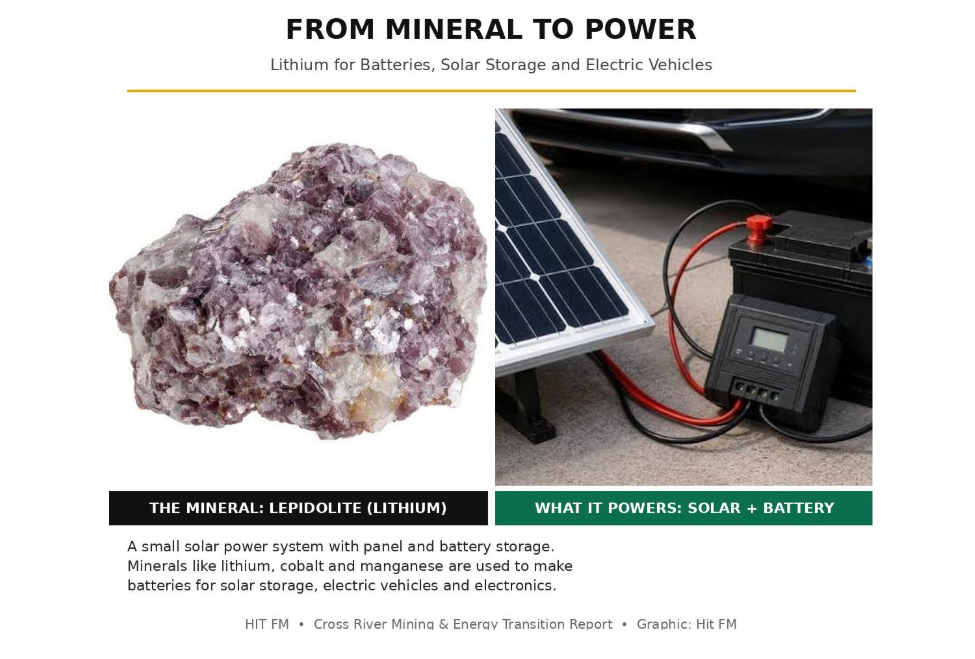
“Minerals like cobalt, lithium, manganese, graphite and rare earth are the backbone when we are making batteries, and they are also good in terms of energy storage, like solar storage, the use of electric vehicles and electronics. In Nigeria today, we cannot just talk about energy transition and solar mini-grids or reducing the dependence on petrol generators without these minerals. We can also export them, but our own local manufacturing and energy security is very important in order for us to achieve energy transition.”
Hit FM sought the response of the CEO of B4Live Intergrated Services, a local mining company, Eno Mbang, on what minerals he is mining and how it helps Nigeria’s energy transition goals. He was first contacted on Saturday, and again on Monday with a 7pm deadline.
As at the time of this report, he had not responded.

However, the State Commissioner for Mineral Resources, Effiom Ekaha-Otu, has called on the Mining Cadastre Office to undertake a technical review of the overlapping licences. He said economic development and environmental conservation can both be achieved through proper planning, inter-governmental cooperation and strict compliance with the law.
“Where a commercially viable mineral deposit extends beyond the Park boundaries, exploration and mining can be undertaken outside the protected areas, subject to the necessary approvals, environmental impact assessment, community development agreement and environmental safeguards.
Our position in Cross River State is clear: we must develop our mineral resources, create employment and attract investment, but not at the expense of our ecological heritage. We can pursue economic development and environmental conservation together, through proper planning, intergovernmental cooperation and strict compliance with the law.”
